
World of Tanks: an honest overview for new players
Disclosure. This page contains partner (affiliate) links, each marked “Partner link”. Chrupinvest s.r.o., the publisher of celaris.online, may receive a commission if you register or make a purchase after clicking one; the price you pay does not change. Partners do not review or approve our content.
celaris.online is not affiliated with, endorsed by or sponsored by Wargaming or World of Tanks.
How the game works, what it does well, where it is weaker, and what you should know about the free-to-play model before you download it.
World of Tanks is a free-to-play online game in which two teams of players fight in armoured vehicles from roughly the First World War to the early Cold War. It was developed by Wargaming, a company now headquartered in Nicosia, Cyprus, and was first released in 2010. More than fifteen years later it is still updated regularly and remains one of the best-known team-based vehicle combat games on PC.
This guide explains how the game actually works, so you can decide whether it is for you before you spend any time or money on it. We have tried to be precise about what is free, what is optional and what varies by region or update.
What World of Tanks is
The name covers three related but separate games. This site is about the PC edition, which runs on Windows. The console edition (released under the name World of Tanks Modern Armor) and the mobile-first World of Tanks Blitz share the theme and some vehicles, but they have their own rules, vehicle lists and progression.
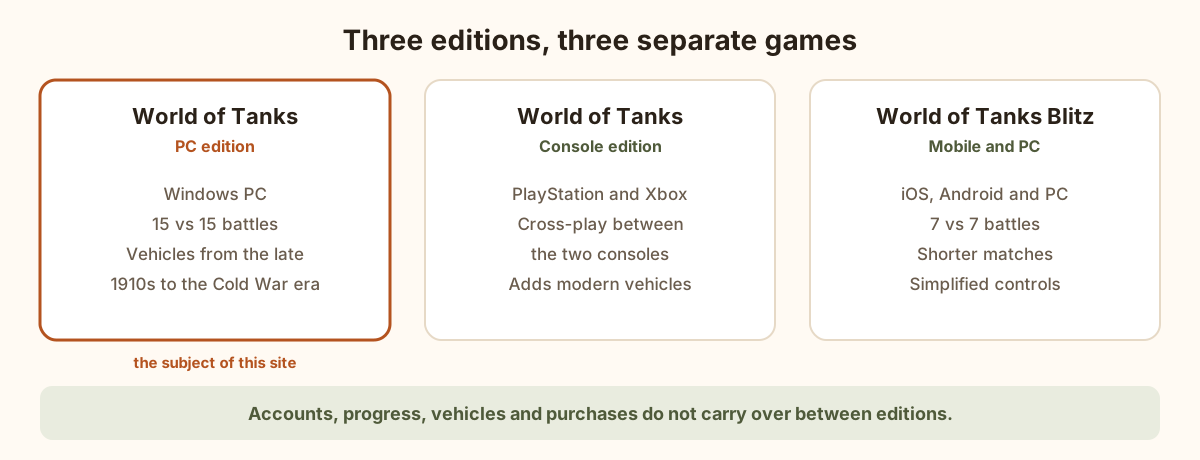
That distinction matters: you cannot play the PC edition against friends on a phone or console. The console edition supports cross-play between PlayStation and Xbox, and Blitz can be played on mobile and PC, but each is a separate game with separate servers. Also check the official system requirements before you download: support for operating systems such as macOS has changed over the years.
Availability also differs by region. Since 2022 Wargaming no longer operates the game in Russia and Belarus, where a separate company runs a localised version under a different name. Players elsewhere choose a regional server cluster (for example Europe, North America or Asia) when they create an account.
Want to see it for yourself?
Try World of Tanks (free to play)Partner linkPartner link: if you register or buy after clicking, Chrupinvest s.r.o. may earn a commission. It costs you nothing extra and does not affect what we write.
How a battle works
In the standard mode, known as Random Battles, the matchmaker puts you into one of two teams of fifteen players. A standard battle is won by destroying every enemy vehicle or by capturing the enemy base — driving into its capture circle and staying there, undisturbed, long enough for the capture bar to fill. Battles have a time limit of 15 minutes, and many finish sooner. Variants such as Encounter (one neutral base) and Assault (one team defends) change the objectives.
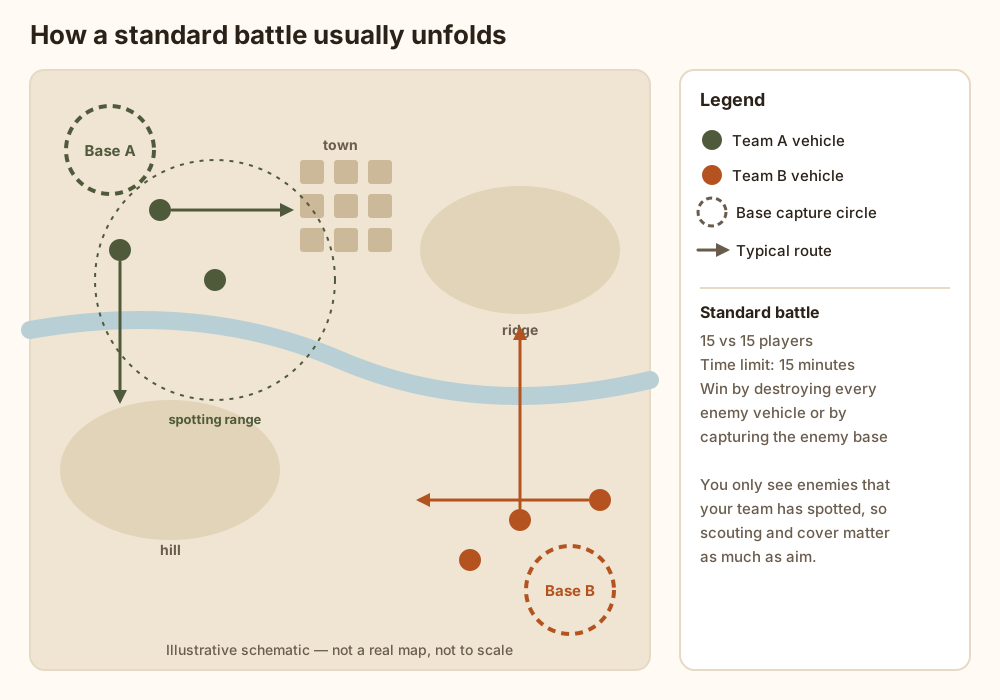
The central mechanic is spotting. You only see an enemy vehicle once someone on your team detects it, and detection depends on view range, camouflage, bushes, movement and firing. A well-hidden vehicle can fire several shots before it is revealed. That is why positioning, cover and map knowledge matter as much as aim — and why a battle can be decided by who sees whom first.
Armour is modelled in some detail. A shell's ability to penetrate depends on the armour thickness, the angle at which it hits and the ammunition type. Angling your hull, hiding weak spots behind terrain and aiming for an enemy's thinner areas are core skills.
Why players like it
The appeal lies in its blend of tactics and action. Positioning, teamwork and knowing your vehicle's strengths often matter more than raw reflexes, so players who like to plan — studying maps, learning where to hold and when to push — tend to enjoy it. Individual battles are short enough to fit into a lunch break, while the long-term goal of unlocking new vehicles gives a sense of progress over months.
Players also mention the variety of vehicles and roles, the fact that you can play competitively without paying, and an active community producing guides, videos and tournaments. Wargaming has kept adding vehicles, maps and modes throughout the game's life.
It is worth being realistic too. Random Battles can feel one-sided, some players find the pace slow compared with shooters, and the game rewards knowledge that takes time to build. Whether it “clicks” is personal — the free entry point is the best way to find out.
The five vehicle classes
Every vehicle belongs to one of five classes, and each class does a different job for the team:
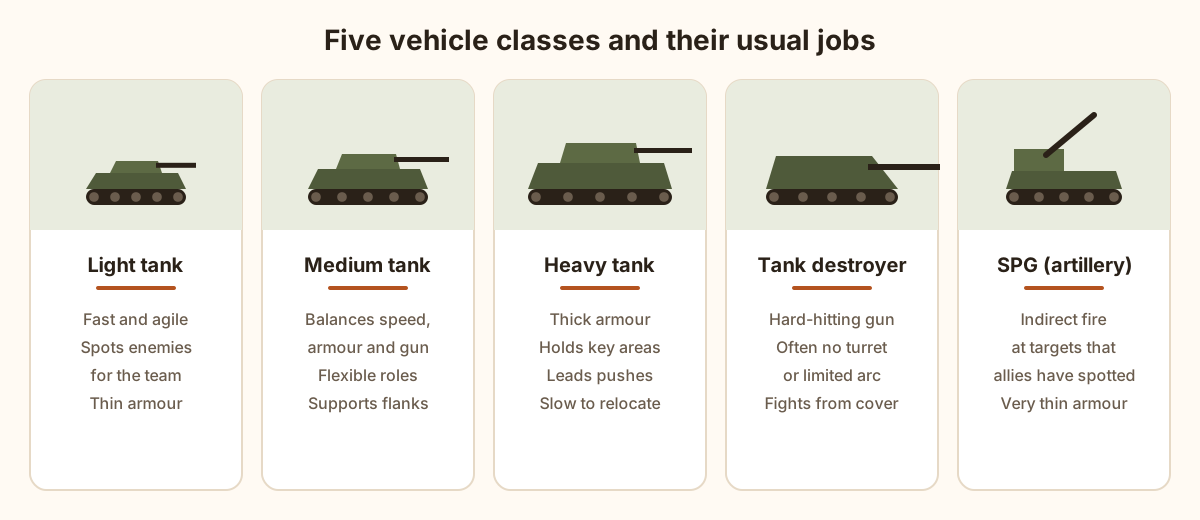
- Light tanks are fast and usually have good view range. Their main job is to spot enemies for the team without being hit.
- Medium tanks balance speed, armour and firepower, and adapt to the situation.
- Heavy tanks have thick armour and big guns. They hold key positions and lead pushes, but relocate slowly.
- Tank destroyers carry hard-hitting guns and are often hard to spot, but many have no rotating turret or only a limited arc of fire.
- Self-propelled guns (SPGs, “artillery”) fire indirectly over long distances at targets spotted by allies. They are fragile, and their shells can briefly stun the crews of vehicles they hit.
Our vehicle classes guide goes deeper into each role and common beginner mistakes.
Nations and the tech tree
Vehicles are organised into national tech trees. At the time of writing the PC edition has eleven: the USA, Germany, the USSR, the United Kingdom, France, China, Japan, Czechoslovakia, Sweden, Poland and Italy. Each nation has its own branches and design tendencies, which gives several hundred vehicles to explore overall.
An earlier version of this page claimed that every vehicle is a real tank with authentic statistics. That is not accurate. Many vehicles did serve, but a large share are prototypes or designs that never left the drawing board, and some are conceptual reconstructions based on partial documents. Performance figures in the game are set for balance and gameplay, not copied from historical records. The historical theme is real; “historical accuracy” in the strict sense is not the goal.
Alongside researchable vehicles there are premium vehicles, bought with gold or real money or obtained through events. They do not need to be researched and typically earn more credits per battle. They are not intended to outperform comparable regular vehicles, although players argue about individual models. Buying one does not give you a guaranteed advantage.
Progression and the in-game economy
After each battle you earn experience (XP) and credits, with more for dealing damage, spotting and winning. XP researches better modules (guns, engines, tracks, turrets) and eventually the next vehicle in a branch. Credits pay for buying vehicles and equipment and for repairs and ammunition. A small share of your XP also becomes free XP, which you can spend on any vehicle.
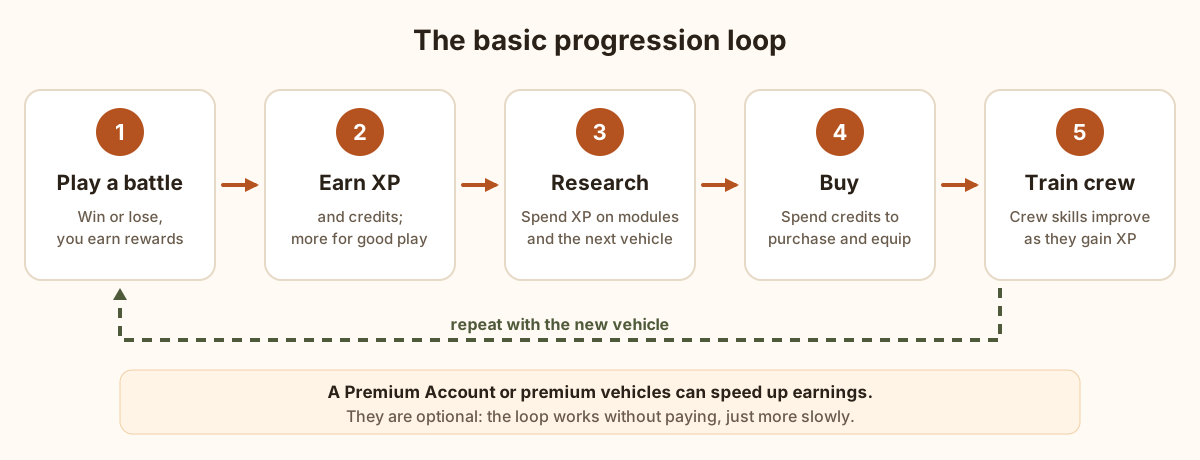
Each vehicle has a crew whose members improve with experience and can learn skills that affect things like repair speed or camouflage. The crew system has been reworked in recent years, so older guides that list specific “must-have” skills may no longer apply; the in-game descriptions are the reliable reference.
Higher-tier vehicles cost more to run. Repair and ammunition costs rise with tier, so many players keep a few lower-tier or premium vehicles to earn credits.
Tiers and matchmaking
Vehicles are ranked by tier, starting at Tier I. For most of the game’s history the top tier has been X; check the in-game tech tree for the current ceiling, as the structure has been revised over time. The matchmaker places you in battles with vehicles of similar tiers, typically no more than two tiers above or below your own, and limits how many different tiers appear in one battle.
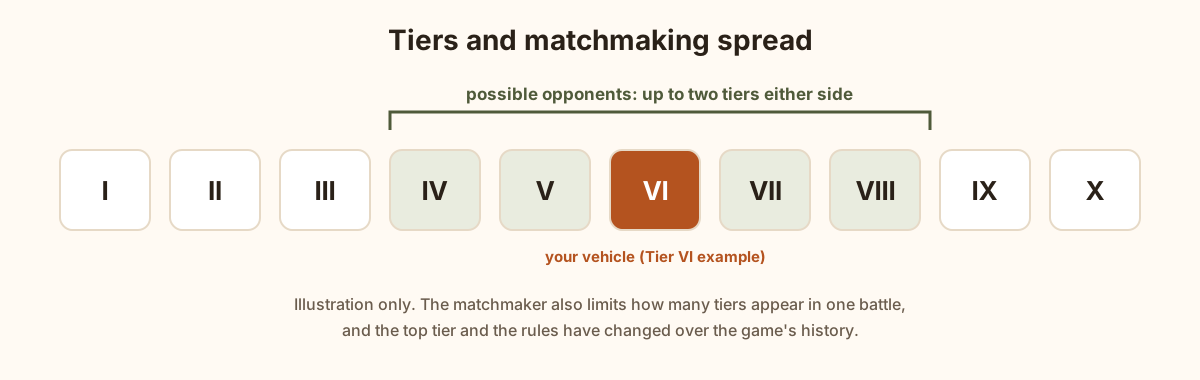
In practice this means you will sometimes be the lowest-tier vehicle in a battle and have to play more cautiously, and sometimes the top tier and expected to lead.
Is it really free?
Yes, in the sense that you can download the PC edition, play every standard mode and research every regular vehicle without paying. The game makes money from optional purchases:
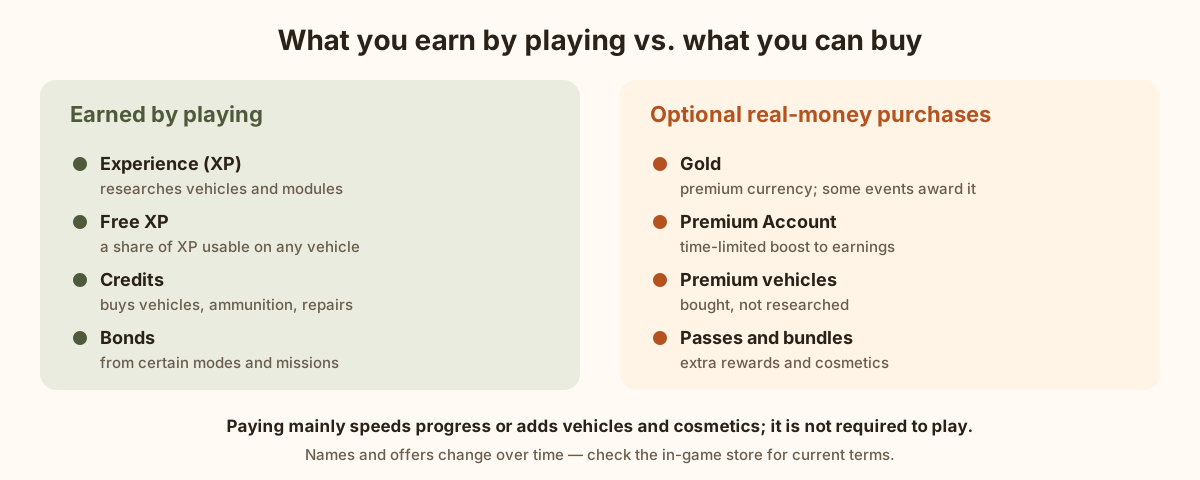
- Gold — the premium currency, bought with real money (some events and missions also award it).
- Premium Account — a time-limited subscription that increases XP and credit earnings.
- Premium vehicles — bought rather than researched; they usually earn more credits.
- Battle Pass upgrades, bundles and cosmetics — extra rewards, camouflages and decorations.
Paying mainly speeds up progress. Without it, climbing the higher tiers takes considerably longer, and upkeep at the top tiers can make earning credits harder. Some seasonal events have also sold randomised reward boxes; see our premium and spending guide for how to keep costs under control.
Strengths and limitations
| Strengths | Limitations |
|---|---|
| Free to download and play; no purchase needed to research regular vehicles | Progress at higher tiers is slow without a Premium Account or premium vehicles |
| Tactical depth: spotting, armour angling and map knowledge reward learning | A steep learning curve; new players are often outmatched at first |
| Short battles (up to 15 minutes) that suit limited play time | Random Battles can be one-sided, which some find frustrating |
| Several hundred vehicles across eleven nations | Not strictly historical: many vehicles are prototypes or paper designs, and stats are balanced for play |
| Long-running game with regular updates and events | No cross-play between the PC, console and Blitz editions |
Wargaming adjusts vehicles and mechanics through balance updates, but no online game is perfectly balanced. Skill and teamwork decide most battles, while the vehicle, the map and the matchmaking also play a part.
Updates, modes and events
Beyond Random Battles, the game has offered a changing mix of modes: competitive ranked-style modes, large-scale modes with more players on bigger maps, clan-based competition on a strategic map, training rooms, and limited-time event modes. Which ones are available depends on the season, so check the official news page for the current line-up.
Updates add new vehicles and maps, rework old ones and adjust balance. Patch notes are published on the official website, and major changes are usually tested on a public test server first. The developers do take community feedback into account, though, as in any live game, not every change is popular.
Getting started
- Download only from official sources — the official World of Tanks website or a store page it links to.
- Create a Wargaming account and choose your regional server. Use a unique password and turn on the account’s additional security options.
- Complete the tutorial. It covers movement, aiming and basic tactics against computer-controlled opponents.
- Play low tiers of several classes before committing to one line. Low-tier battles are quick and cheap.
- Take it slowly. Rushing to high tiers before you understand spotting and armour is the most common beginner mistake.
Our beginner’s guide has a full first-week plan.
Ready to roll out?
Create a free World of Tanks accountPartner linkPartner link: if you register or buy after clicking, Chrupinvest s.r.o. may earn a commission. It costs you nothing extra and does not affect what we write.
Fair play and account safety
Wargaming’s Fair Play Policy bans modifications that give an unfair advantage and bans cheating, bots and account sharing for profit. Some cosmetic or interface mods are tolerated; the policy lists what is prohibited, and using a banned mod can get an account suspended.
Be wary of websites, videos or messages promising “free gold” or free premium vehicles in exchange for your login. They are a common phishing method. Wargaming’s terms also prohibit buying and selling accounts, and purchased accounts are often recovered by their original owner.
Younger players and spending
Check the game’s age rating for your country (for Europe, in the PEGI database) and the in-game purchase notice. If a child plays, use the parental controls and spending limits of the device or platform, and do not store a payment card on the account. The game includes real-money purchases, and some events have included paid randomised rewards.
Frequently asked questions
Do I need to pay to enjoy World of Tanks?
No. All standard modes and regular vehicles are available without paying. Paying speeds up progress and adds premium vehicles and cosmetics.
Can I play with friends on console or mobile?
Not from the PC edition. The console edition and Blitz are separate games; you would all need to play the same edition.
Are the tanks historically accurate?
Partly. The vehicles are based on real designs, but many are prototypes or paper projects, and their in-game performance is balanced for gameplay.
Do premium tanks win battles for you?
No. Their main benefit is higher credit earnings and skipping research. Skill, position and teamwork matter far more.
How long is a battle?
A standard Random Battle has a 15-minute limit; many end earlier.
Sources
- Wargaming, official World of Tanks website (game guide, patch notes, system requirements): worldoftanks.eu / worldoftanks.com
- Wargaming, corporate website: wargaming.com
- Wargaming legal documents (End User Licence Agreement, Terms of Service, Fair Play Policy): legal.eu.wargaming.net
- World of Tanks console edition: console.worldoftanks.com
- World of Tanks Blitz: wotblitz.eu
- PEGI age ratings database: pegi.info
We describe the game from these official sources and from the game client itself. Where we could not confirm a detail, we have described it in general terms rather than give a figure.
Official information prevails
Games like World of Tanks change with every update. We check our pages against official sources at the date shown above, but prices, platforms, rules, events and vehicle statistics can change without notice. If anything here differs from information published by Wargaming (on its websites, in the game client or in its legal terms), Wargaming’s information prevails. Spotted a mistake? See our corrections procedure.
About the visuals: every illustration and diagram on this page is an original work drawn for celaris.online. None of them is a screenshot, official artwork or a reproduction of an in-game model.
World of Tanks, World of Tanks Blitz and Wargaming are trademarks or registered trademarks of Wargaming group companies. celaris.online is an independent publication and is not affiliated with, endorsed by or sponsored by Wargaming or any of its companies. Other names may be trademarks of their respective owners.
About the author
Lucas Ward is the editor of celaris.online and is responsible for its content on behalf of Chrupinvest s.r.o.. Read how we research and fund this site in our editorial policy.